Education in Ireland fair happening in Pune on 29th September 2024 • Applications for September 2025 intake for Trinity College Dublin, Dublin CIty University and University of Galway are commencing from 1st October 2024 • University College Cork’s applications are commencing from 14th October 2024 •
What Is NFQ Level 9 in Ireland? A Guide for International Students
October 15, 2026
6
min read
Find out what NFQ Level 9 means in Ireland, including master’s degrees, postgraduate diplomas, entry requirements and post-study work options for students.
Choosing a postgraduate course in Ireland? Understanding NFQ Level 9 can help you compare qualifications, plan your studies and make informed decisions about your future.
What Is NFQ Level 9 in Ireland?
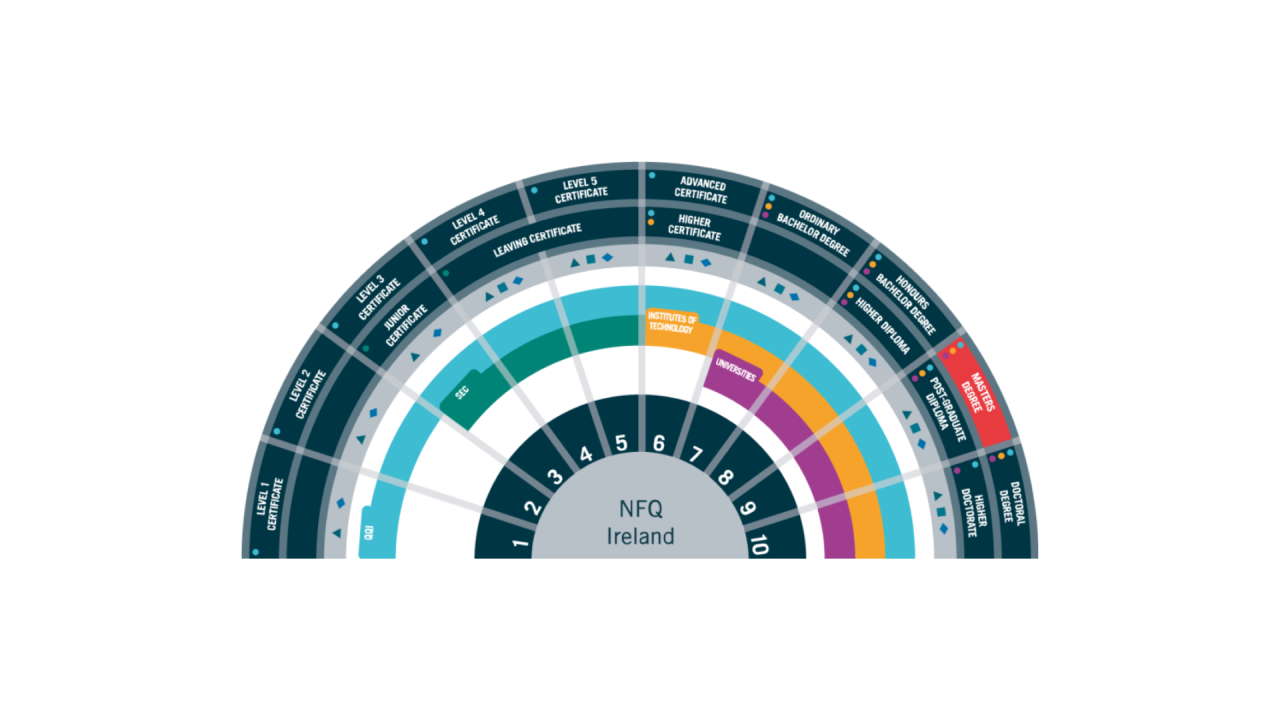
The National Framework of Qualifications (NFQ) is Ireland’s 10-level system for classifying qualifications across education and training. Each level represents particular learning outcomes and helps students, employers and institutions understand the standard of a qualification.
NFQ Level 9 represents postgraduate education and includes master’s degrees and postgraduate diplomas. It sits above Level 8, which includes honours bachelor’s degrees, and below Level 10, which covers doctoral degrees. This framework helps students understand where a qualification fits within Ireland’s education system.
Which Qualifications Come Under NFQ Level 9?
Two major qualifications are associated with NFQ Level 9. Although both are postgraduate awards, their structure and purpose can differ.
1. Master’s Degree
A master’s degree allows students to develop advanced knowledge in a specific subject. In Ireland, taught master’s programmes typically take one to two years to complete and carry 60–120 European Credit Transfer and Accumulation System (ECTS) credits.
Research master’s programmes typically take around two years, although their structure and credit arrangements can differ. Depending on the subject, students may complete coursework, projects, research or a dissertation.
2. Postgraduate Diploma
A postgraduate diploma is another Level 9 qualification, normally completed over one year and carrying 60 ECTS credits. It is generally designed for graduates seeking specialised knowledge without necessarily undertaking a full master’s programme.
The right option depends on your academic background, career plans and the specific course requirements. Always check the qualification awarded rather than relying on the course title alone.
Source: Quality and Qualifications Ireland (QQI), National Framework of Qualifications.
What Are the Entry Requirements for NFQ Level 9 Courses?
Most Level 9 programmes require a relevant undergraduate qualification. For taught master’s courses, an honours bachelor’s degree is a typical entry requirement. However, some institutions may consider applicants with an ordinary bachelor’s degree or equivalent qualifications, particularly when relevant work experience is available.
Research master’s programmes may require a stronger academic record and evidence of research readiness. Requirements also vary by subject. Business, engineering, computer science and other specialised programmes can have different academic prerequisites.
International applicants should review the university’s academic eligibility criteria, English-language requirements and application deadlines before applying. Meeting the minimum requirements does not guarantee admission, as universities may assess applications competitively.
What Are the Benefits of Studying an NFQ Level 9 Course?
A Level 9 qualification can help students build expertise beyond undergraduate study. Depending on the course, this may include advanced technical skills, research experience, industry projects or specialised business knowledge.
For students planning an international career, studying in Ireland can also provide exposure to a different academic environment and opportunities to develop professional networks. However, career outcomes depend on the course chosen, prior experience, individual skills and employer requirements. A postgraduate qualification alone does not guarantee employment.
Can You Stay in Ireland After Completing NFQ Level 9?
This is an important consideration for international students planning their studies. Under Ireland’s Third Level Graduate Programme, eligible non-EEA graduates who complete a qualifying Level 9 or higher award may receive permission to remain in Ireland for up to 24 months on Stamp 1G.
The permission is generally granted for an initial 12 months, with a further 12-month period available subject to the programme’s conditions. Graduates must meet the applicable eligibility and immigration requirements.
Stamp 1G gives eligible graduates time to seek graduate-level employment and explore suitable employment permit options. However, it is not a work permit for unrestricted long-term employment, nor does it automatically lead to permanent residence.
Students should check the latest requirements on the official Irish Immigration Service website before making decisions based on post-study work opportunities.
Is NFQ Level 9 Right for You?
Before choosing a Level 9 course, consider these factors:
Career goals: Check whether the qualification supports your intended career path.
Course structure: Compare modules, research components, projects and placement opportunities where available.
Total cost: Calculate tuition fees, accommodation, living expenses and other study-related costs.
Entry requirements: Confirm that your previous qualification and academic results meet the university’s criteria.
Post-study plans: Understand the conditions attached to graduate immigration permission rather than assuming you will automatically qualify.
Taking time to compare these details can help you select a programme that fits both your academic background and longer-term plans.
Final Thoughts
NFQ Level 9 is an important part of Ireland’s postgraduate education system, covering master’s degrees and postgraduate diplomas. For international students, understanding the qualification level, admission requirements, course structure and post-study options can make the decision-making process clearer.
If you are planning to study in Ireland, Onebounce can help you explore suitable courses, understand university requirements and navigate the application process. The right course choice starts with understanding your options and how they fit your future plans.
Start Preparing for English Tests
Get more details about the University
Get more details about the Course
Get Job Referrals to move abroad
Clarify doubts with our expert Counsellor for Free
Check your eligibility with our finance expert
Get latest udpates about the country
Write a winning SOP/LOR for your university
Enter your mobile number and get a callback from our counsellor.
Thank you! One of our counsellor will call you soon.
Oops! Something went wrong while submitting the form.