Education in Ireland fair happening in Pune on 29th September 2024 • Applications for September 2025 intake for Trinity College Dublin, Dublin CIty University and University of Galway are commencing from 1st October 2024 • University College Cork’s applications are commencing from 14th October 2024 •
Why Galway Is Becoming a Serious Alternative to Dublin for Indian Students
September 15, 2026
6
min read
Why Galway is becoming a serious alternative to Dublin for Indian students: compare courses, costs, jobs, and lifestyle to see if Galway suits your future.
For many Indian students planning to study in Ireland, Dublin is often the first city that comes to mind. It is home to several major universities and a large concentration of international companies. But there is another Irish city worth looking at closely.
Galway has a strong university, a growing technology and medtech sector, and a student-focused environment that can make it an attractive alternative to Dublin. For students choosing where to study and build their early career, Galway deserves a place on the list.
A Strong University in a Student City
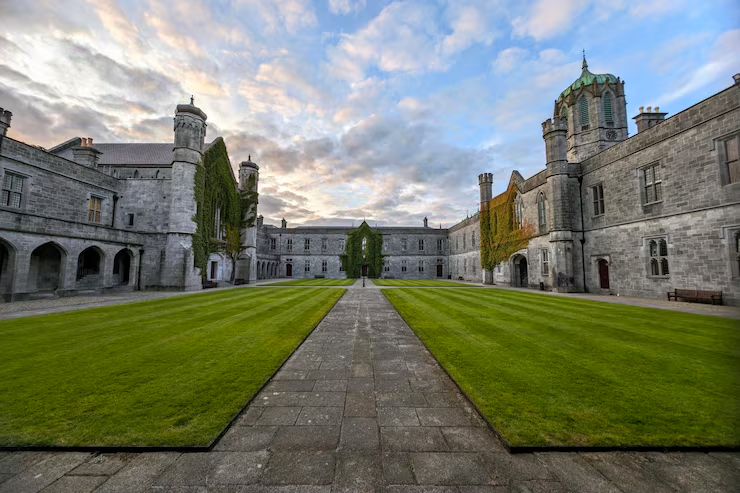
The University of Galway is one of Ireland's established universities and is ranked 284th in the QS World University Rankings 2026, placing it among the top 2% of universities globally. It also has more than 19,000 students, including students from over 120 countries.
The university's location is another advantage. Its campus is close to the city centre, and students make up around 20% of Galway's population. This gives the city a distinctly student-oriented atmosphere without the scale of a capital city.
Courses That Match Today's Job Market
Galway offers postgraduate options across technology, business, engineering and healthcare. Some programmes that may interest international students include:
MSc Business Analytics
MSc International Management
MSc Marketing Management
MSc Computer Science
MSc Computer Science: Artificial Intelligence
MSc Computer Science: Data Analytics
MSc Adaptive Cybersecurity
MSc Intelligent Robotics
MSc Biomedical Engineering
MSc Medical Electronics & Digital Health
The range is particularly interesting for students who want to combine technology and business or specialise in areas connected to Ireland's growing medtech and technology industries.
Galway Has More Than a Student Economy
One of Galway's biggest advantages is its connection to industries that are already well established in the region.
Galway is recognised as a major centre for medical technology and ICT. The city also has activity across manufacturing, business services, digital media and start-ups. Galway City Council identifies ICT, medtech and medical-device manufacturing as important parts of the city's employment base.
The wider western region also has a significant multinational presence. IDA Ireland reports that counties Galway, Mayo and Roscommon host 130 multinational companies employing more than 31,000 people. In Galway specifically, Boston Scientific and Medtronic together employ close to 8,000 people.
For students studying engineering, data, computing, life sciences or business, this creates a relevant industry ecosystem close to the university.
Is Galway Cheaper Than Dublin?
This is where students need to be careful. Galway should not simply be described as a cheaper Dublin.
Accommodation can still be expensive and finding a room requires planning. The University of Galway currently estimates that a single room in a shared house can cost around €700 to €1,200 per month, depending on the property and location. Digs can range from approximately €150 to €250 per week.
So, the attraction is not necessarily that everything costs less. Instead, students may find value in the city's scale, location and lifestyle, depending on where they live and how they manage their budget.
What About Part-Time Work?
International students on eligible Stamp 2 permission can generally work up to 20 hours per week during term time and up to 40 hours per week during designated holiday periods.
Galway has opportunities across sectors such as hospitality, retail, healthcare, technology and services. However, part-time work should be treated as a way to gain experience and supplement your finances, not as the primary way to fund your education.
Galway or Dublin: Which Should You Choose?
Dublin may make more sense if you want access to a much larger metropolitan job market and a wider concentration of universities and multinational employers.
Galway can be a strong alternative if you prefer a smaller student city, want access to the University of Galway's specialist programmes, and are interested in sectors such as medtech, technology, engineering or business.
The decision ultimately comes down to your course, budget and career plans rather than simply choosing the bigger city.
Final Thoughts
Galway may not replace Dublin for every student, but it offers a compelling combination of quality education, industry opportunities and student life. With the University of Galway and established technology and medtech sectors, it is increasingly worth considering for Indian students planning their studies in Ireland.
At Onebounce, we help students compare universities, courses and destinations based on their academic profile and career goals, so you can look beyond the obvious choices and find the option that fits you best.
Start Preparing for English Tests
Get more details about the University
Get more details about the Course
Get Job Referrals to move abroad
Clarify doubts with our expert Counsellor for Free
Check your eligibility with our finance expert
Get latest udpates about the country
Write a winning SOP/LOR for your university
Enter your mobile number and get a callback from our counsellor.
Thank you! One of our counsellor will call you soon.
Oops! Something went wrong while submitting the form.




.avif)